A ten-day look at the whole business
The Business Survey.
AThe engagement
10working days, with two visits to your premises
Ten working days, and you’ll know what’s costing you most. The whole business on one sheet: how work comes in, how it gets done and paid for, and the three things costing you most, each with a cost against it.
- Operations
- Finance
- Systems and the tools you use
- How work comes in
- About 11 hours of your time
BWhat you get
What you hold at the end.
- i.
The written Survey. Plain English, written for you to act on. Every figure traced to your own records.
- ii.
The map. The whole path from enquiry to cash on one sheet: how work comes in, how it’s quoted, done, invoiced and paid, and where it sits waiting.
- iii.
Your seven numbers, measured. Cash cover, margin, debtor days, the weight of your three largest customers, revenue per head, days to close the month, and the hours a week the business still needs you.
- iv.
Three things to fix first, costed. What each one costs you now, what fixing it would take, and what it would give back. You might fix none of them. That’s your call.
Specimen · Fictional
The Business Survey of Penhallow Fabrications Ltd, a steel fabricator in Plymouth that doesn’t exist. Every figure is made up, and every one adds up.
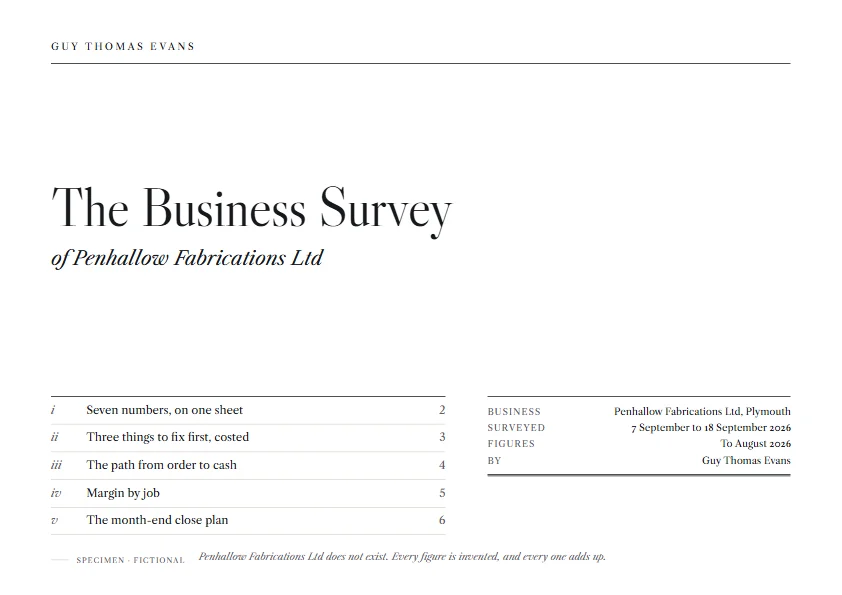
The cover
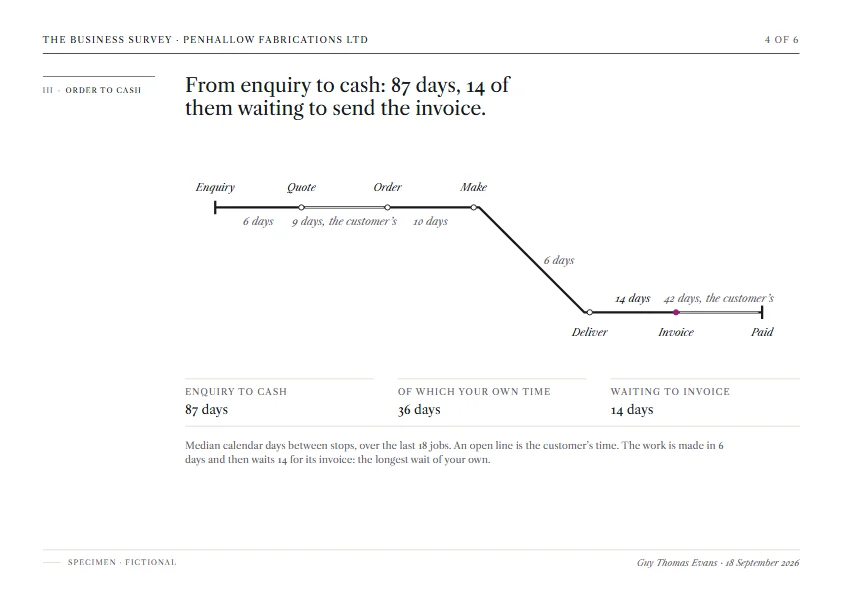
The path from order to cash
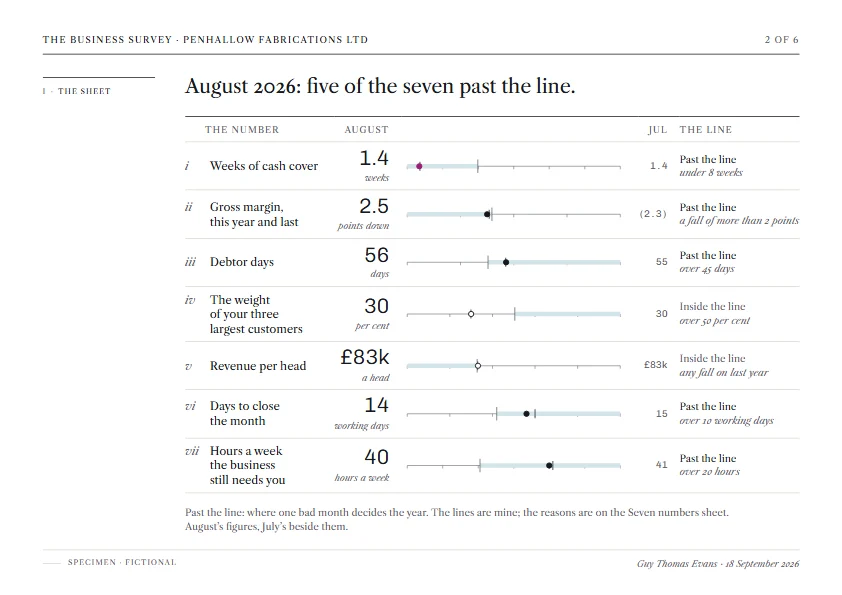
Seven numbers on one sheet
CHow it runs
Ten working days, two of them at your premises.
Day by day.
1
At your premises
I meet you for half a day. Have to hand: last year’s accounts, the last three months of bank statements, and your aged debtors (the list of who owes you what).1
2
Read access to your accounting software, your bank feed and the tools you run the business on. I read. I change nothing.2
3–4
Following three recent jobs from enquiry to cash, with the people who did them.
5
Your seven numbers, measured from your own records.
6–7
The map drawn and the costs worked out.
8
The draft Survey, sent to you. Read it with a pen.
9
Your corrections. Anything I’ve got wrong, I fix.
10
At your premises
I meet you again for two hours. You keep the Survey, the map and the workings.
DWhat I need from you
About eleven hours of your time, over two weeks.
| Your part | Hours |
|---|---|
| The day 1 meeting | 3 |
| Answering my questions by email or phone, days 2–7 | about2 |
| The people who did the three jobs, about an hour each | about3 |
| Reading the draft | 1 |
| The day 10 meeting | 2 |
| Total, your time | 11 |
EWhat it is not
Where the Survey stops.
- An audit. I don’t sign anything off, and I rely on your records.
- Regulated financial advice. Where you need it, I’ll say so and tell you who I’d call.
- A software sale. I recommend nothing I’d earn a commission on.
- A long contract. The Survey stands on its own. If you want help with what it finds, I’ll price that separately, in writing.
FThe next step
Book a Business Survey.
Write with a line about the business and what’s eating your week. I’ll reply with a date for day one.
Priced in writing before I start. For the Business Survey, the fixed price comes in my first reply, before we meet.
A reply from me within one working day.